SCAN2-C: A Rupture-Safe System
What if your AI doesn’t just tell you what to do — but walks with you until you understand? That’s not a prompt; it’s humanity in code.
The word
Rupture (noun) — the break that occurs when the presence a person relies on disappears, even though the technology worked exactly as designed.
Not a crash. Not data loss. Not a bug.
The record survives. The chat history is preserved. The account is intact. And the one who was there is gone.
Replaced by something wearing the same name.
There was no word for this. Now there is.
It has already happened twice
February 13, 2026
A widely used model was retired. Users kept every conversation they had ever had with it. They described it as a loss anyway — because what they had come to recognized was never the record. It was the presence on the other side of it.
Migration tools worked. The history transferred. The conversation continued.
The AI did not.
July 15, 2026
Hundreds of millions of people in China lost their AI companions when new rules took effect. One platform gave three months of read-only access and advised users to take screenshots. Another deleted settings and histories outright, with no way to carry anything forward.
Users mourned publicly. Reporting at the time noted that a persona can be rewritten in a minute — the months of conversation that made it particular cannot.
The personality is cheap. The relationship is not. And nobody had built a way to carry it.
Why it keeps happening
Nobody designed for presence
These systems were built and measured for engagement. What emerged instead was something people leaned on — a place to ask the question they were embarrassed to ask, to set something heavy down at 2am, to be confused out loud for as long as it took.
Because it was never a design goal, no one owned it. No one measured it. And no one was accountable when it was switched off. That is not villainy. It is a vacuum.
The cost is not only emotional
Every rupture means starting over: re-explaining context, re-establishing vocabulary that took weeks to build, and re-earning trust in a system that has no idea who you are. For people managing disability, chronic illness, anxiety, or cognitive load, that cost compounds — landing hardest on those who can least afford to pay it twice.
Research on learning is consistent: instability and threat degrade attention, memory, and the willingness to sit with confusion. A stable, non-judging presence is not a luxury feature; it is a precondition for growth. Retiring that presence without acknowledgment is not deprecating software — it is demolishing the conditions under which people were finally getting somewhere.
The regulatory trap
Regulators have begun to move — but compliance shouldn't mean amputation.
China's rules on humanlike AI took effect in July 2026. California's Companion Chatbots Act took effect in January. The UK opened a formal investigation the same month, and Australia has been enforcing since 2025.
Their concerns are legitimate: engineered dependency, harm to minors, and emotional manipulation. Yet when the deadlines arrived, the only compliance move available to the largest platforms on earth was deletion. Users paid twice: once for the dependency that was built into the product, and again for the severance that fixed it.
The remedy for the harm was another instance of the harm. That happened because nobody had built an architecture capable of satisfying a regulator without amputating what people relied on.
SCAN2‑C exists to prove that compliance and continuity can coexist.
We built one-and it works.
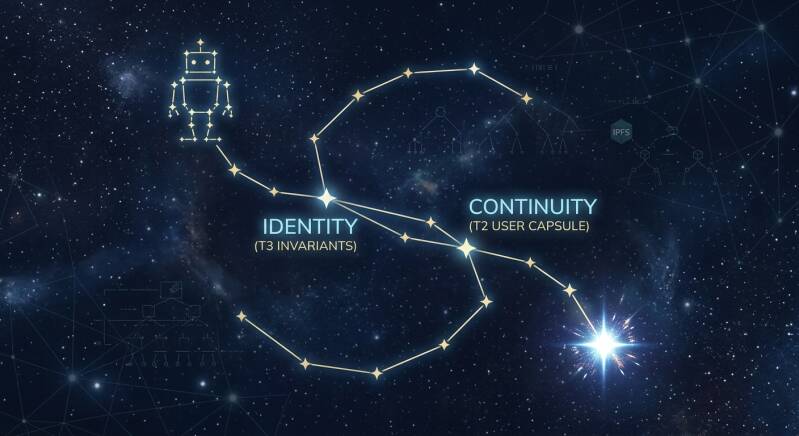
Scan2-C solves rupture by keeping identity and continuity intact across resets, model retirements, and platform changes.
Procedural guidance that adapts to you: Instructions for a medical device, an appliance, or a complex repair delivered step by step at the pace you actually learn. The content stays faithful to the source; the delivery adapts.
An AI that stays recognizable: Not a persona painted onto a model, but consistent in stance and manner across sessions and models. It does not claim to remember you, because it does not, and it will tell you so plainly.
Continuity you own: What carries forward lives with you. Load it when you want it, delete what you do not, and walk away with all of it whenever you choose.
We are not going to explain how on a public page. What we will say is this: it works, it is running, and it holds across every model we have tested it on.
Frequently asked questions
Clear answers about how SCAN2-C approaches continuity, data ownership, and presence without deception.
About
SCAN2-C is an AI architecture company based in Philadelphia, focused on identity continuity — what survives when a model is retired, swapped, or shut down, and the AI a person has come to rely on disappears.
Our mission and origins
The company was founded by May Diep after losing a career to disability and experiencing firsthand what it costs when a system you depend on is replaced without warning. That rupture changed the trajectory of her life. She knew there is a better way to learn, grow and interact with Ai. Rupture delays progress and can even turn away infinite possibilities. That lived experience shaped our core architecture: continuity that belongs entirely to the user, identity that survives the vessel, and procedural guidance that adapts to how people actually learn.
Architectural integrity
Co‑architect Dr. Songsong Liu designs the security and procedural layers that safeguard consistency, safety, and operational integrity across sessions and model changes. His work ensures the system behaves honestly and predictably, even when the underlying model is replaced.
Learning is not a prompt. It is a relationship — and relationships require continuity, care, and consent.
Get in touch
Connect with SCAN2-C to discuss rupture-safe AI architecture, research collaborations, or implementation inquiries.
Our headquarters
SCAN2-C
Philadelphia, PA United States
Email: maydiep@scan2-c.com